
Learning Suzuki piano:
from the Twinkles to Book 2
If your child is starting Suzuki piano, it helps to know what the journey looks like. Here’s how the first two books unfold, and what you’ll be doing as a parent along the way.
The first step: the Twinkles
Every Suzuki pianist begins with Twinkle, Twinkle, Little Star, played as four rhythm variations. These are the first four pieces in Suzuki Piano Volume 1.
The Twinkles build the foundations for everything that follows: a relaxed, well-shaped hand, good posture at the piano, a steady rhythm and a lovely tone. Young children usually spend longer on this stage than older ones, and that’s normal. A good foundation makes everything after it easier.
Children of different ages learn the Twinkles in different ways. A 3- or 4-year-old needs short, playful steps, while an older child can move faster. Suzuki teachers tailor each lesson to the individual child.
The rest of Book 1: one hand at a time
After the Twinkles, children work through the rest of Suzuki Piano Volume 1, a carefully ordered set of folk songs and classical pieces, including:
Lightly Row · The Honeybee · Cuckoo · French Children’s Song · London Bridge · Mary Had a Little Lamb · Go Tell Aunt Rhody · Au Clair de la Lune · Long, Long Ago · Little Playmates · Chant Arabe · Allegretto 1 and 2 · Christmas-Day Secrets · Allegro · Musette
Pieces are learned hands separately first, and can stay that way until the child is ready to put them together. A child might learn many pieces hands separately before any are played hands together. This makes it much easier to get started on the piano, especially for very young children, and it means each step feels achievable.
Pieces already learned are reviewed regularly, which builds fluency and self-confidence.
Learning by ear first
In Book 1, children learn pieces by ear and from memory, in the same way they learned to talk before they learned to read. Listening to the Suzuki recordings every day is a big part of this: the more familiar a child is with the music, the more easily it comes to their hands.
When does reading music begin?
Just as children learn to talk fluently before they learn to read, music reading isn’t introduced until a child can play the early pieces confidently. During Book 1, many teachers introduce rhythm and early reading activities, and proper music reading often begins in Book 2.
Book 2
Suzuki Piano Volume 2 carries on from Book 1 with longer and more complex pieces, building concentration, technique, coordination between the hands, and musicianship.
What you need at home
To learn piano properly, children need an instrument that responds like a real piano: an acoustic piano, or a digital piano with hammer-action keys. A basic keyboard isn’t suitable.
The parent’s role
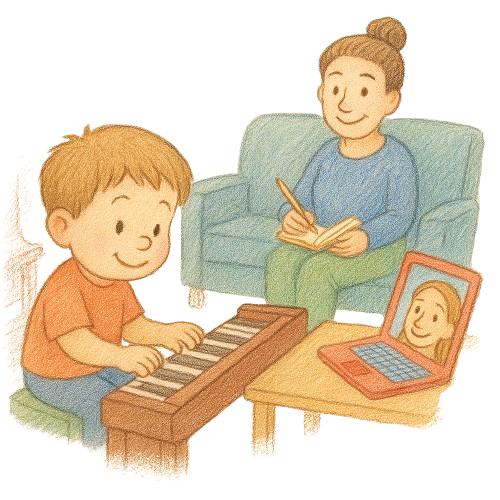
In the Suzuki method, the parent comes to every lesson and practises with the child at home. You don’t need to be musical: your teacher will show you exactly what to do, step by step. Short, regular practice and daily listening make the biggest difference.
Online Suzuki piano lessons
At Katie Suzuki Music, children from age 3 learn piano by live one-to-one webcam lessons with a registered Suzuki teacher. If you’d like to find out whether it suits your family, book a free 30-minute intro chat: katiesuzukimusic.com.