
Keeping practice fun:
ideas for Suzuki parents
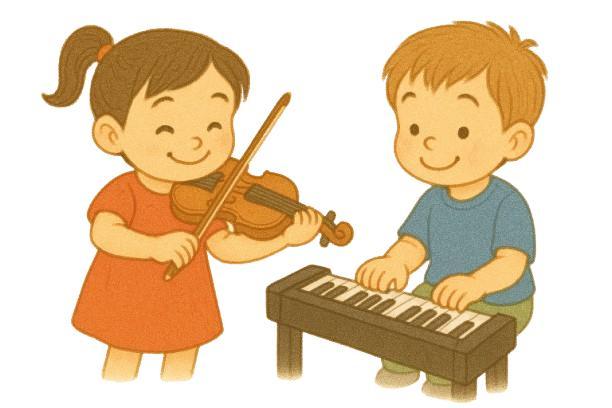
Children will spend hours doing what fascinates them, so it’s worth spending some time coming up with ways to make practice interesting.
Toys, games and charts all have their place, but I suggest you use them as sparingly as possible, both to keep their novelty (for when you really need them!) and so as not to lose sight of the real goal: learning to play music. I call any activity that’s included just for fun a “side-activity”. Keep a list of side-activity ideas, because none of them will work forever!
Below are two lists. The first has general ideas for interesting ways to run a practice session. The second has ideas for repetitions, because repetitions are essential for making any skill automatic.
Ideas for practice sessions
Lego creations
Before the practice session, get your child to build a Lego creation that can be broken into sections. Gradually put it back together, adding another piece each time a practice item is completed.
Dressing dolls
Before the practice session, get your child to prepare a doll and some doll clothes. Gradually dress the doll, putting on one item of clothing after each practice item.
Child as teacher
Let your child be the “teacher” while you (or another adult, or a fluffy toy) try to do whatever your child is learning.
Experiment
Make practice a time of experimentation and discovery. For example: “Let’s see how many times in a row your hand can play that little part correctly. You play and I’ll count.”
Fluffy toy as “checker”
Get a fluffy toy to be the “checker”, watching for one particular aspect of posture or playing.
Do it both ways
Sometimes a child will do something the “wrong” way just because they can’t do it the “right” way, and they don’t want to admit it! Tell them they can choose which way to do it in the piece (for now), but you’d like them to show you that they can play it both ways.
Make a video
Take a video of your child playing. This can be very enlightening, for them and for you.
Fluffy toy concert
Invite some fluffy toys to come and watch a concert of review pieces.
Read a book
Read one page of a story after each practice item.
Running commentary
Sometimes children go through a phase where they can’t accept instruction of any kind from their parent. This can be hard! But sometimes they will accept a running commentary. Perhaps they’ll play for you as long as you don’t ask them to do anything, and you can get away with reflecting (a lot) on what they’re doing. You could bring a few fluffy toy “children” along to listen. Maybe the fluffy toys are learning music too, so you can chat to them about what you’re seeing, whether they find that part difficult as well, and what they might learn from watching your child play. All without actually asking your child to do anything.
For a violin child who keeps wandering off to sit down between pieces
Write a secret note saying something nice, like “I love spending time playing music with you”. Fold it up and have your child put their foot on it while they practise. If they keep it covered until the end of practice, they can read the note. If they leave it uncovered, you take it away and they’ll never know what it said!
Violin children can play in different places
Try playing outside, or in a different room.
Ideas for repetitions
To help repetitions go smoothly, it can help to have another activity going at the same time. Often the best motivator is whatever your child’s current favourite toy or activity is, so think laterally about ways to include it in your practice.
First, check that your child can actually do the thing you’re asking them to repeat. If they can’t do it yet, they probably won’t tolerate repeating it for long. It’s better to make the task easier, so they’re repeating something they can do.
Build a block tower
Add one block for each repetition. How tall can the tower go?
Counters
Use some little items as counters, and move one across each time a correct repetition is played.
Four corners (violin)
Play a short section facing the usual direction. Then your child turns 90 degrees and plays it again. If it’s correct, they turn another 90 degrees and repeat; if not, they go back to the start. Can they play it correctly 3 or 4 times in a row to get all the way around?
Mystery picture
After each correct repetition, draw part of a picture. How many repetitions will it take for your child to guess what it is? Or let your child choose what you’ll draw.
Piano octaves
For piano, your child can play a repetition in each octave.
Car game
Set up a toy car at one end of an area, with a few stops along the route (it could be across the top of the piano). Choose a short section of music to practise. For each completely correct playing (pauses allowed, but no wrong notes), the car moves one stop further along. If there are any wrong notes, the car goes back one stop. Can your child get the car to the other end?
Violin stations
Make a route of “stations” on the floor, such as squares of coloured fabric or cushions. Play a repetition standing on each one. If it’s correct, move forward one station; if not, go back one.
Silly repetitions
Have your child do each repetition while doing something different and silly: sticking out their tongue, closing one eye (or both!), standing on one foot (for violin), and so on. The playing must still be correct!
Online Suzuki lessons
At Katie Suzuki Music, children from age 3 learn Suzuki piano or violin one-to-one by live video with a registered Suzuki teacher, and parents get plenty of support with practice at home. If you’d like to find out whether it suits your family, book a free 30-minute intro chat: katiesuzukimusic.com.